
Motorsport marketing: how businesses use racing to win customers
What motorsport marketing actually is, why it works for small and large businesses alike, and how to get real value from it, from a team that races in the Porsche Carwow Carrera Cup GB and works with partners every round.
By Team Tofty, 8 minute read
What is motorsport marketing?
Motorsport marketing is using racing – a driver, a team, a car or an event – to reach customers and grow a business. Most people picture a logo on a car, and that’s part of it. But on its own, a logo is the least valuable thing a partnership gives you.
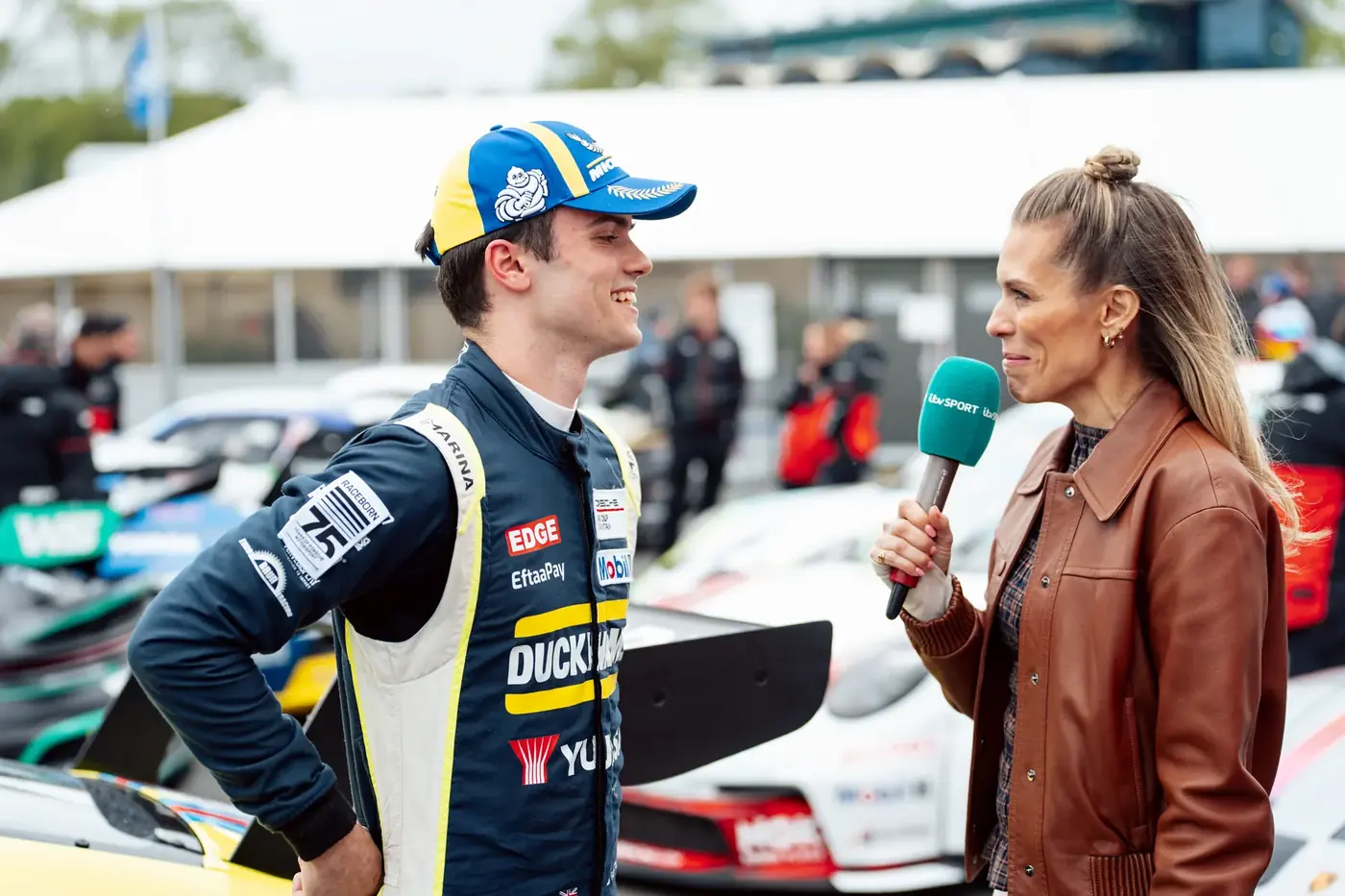
The real value comes from everything around the car: live TV coverage, thousands of fans at the circuit, a paddock you can bring clients into, and a constant stream of content from race weekends. Done properly, motorsport becomes a marketing channel, a hospitality venue and a content studio all at once.
Why it works
Reach that people choose to watch
Racing is content people seek out. The Porsche Carwow Carrera Cup GB races as part of the British Touring Car Championship (BTCC) weekend, shown live and free-to-air on ITV until at least 2029. According to official BTCC figures, the weekend reaches a TV and streaming audience of more than 15 million, draws over 387,000 fans trackside across ten race weekends a year and is watched live in more than 115 countries. Your brand isn’t an advert people skip; it’s part of what they came to watch.
An audience that cares
Motorsport fans are loyal. Over 80% of the BTCC audience would recommend watching it to a friend or colleague, three in four go to more than one event a season, and more than half buy merchandise at events. The crowd is broader than many people expect, too: 40% of the fanbase is female, and almost six in ten fans have a strong interest in cars.
Hospitality that wins business
For B2B companies, this is often where the return is biggest. Taking a client into the paddock, walking them through the garage and putting them in a passenger seat for a hot lap builds a relationship in a way a meeting room can’t.
Content, every round
Every race weekend produces photos, video, interviews and stories. A good partnership gives you the rights to use that content in your own marketing, so your social channels, newsletters and sales decks have something genuinely interesting to share.
The association
Motorsport is about precision, performance and teamwork. Being linked with a professional racing programme, especially one with a brand like Porsche behind the series, says something about how your business works.
A story to be part of
Audiences follow people, not just cars. A driver’s journey gives a partner a story to share across a whole season, not just a logo at one event.
A logo on a car is where a partnership starts, not where the value comes from.
What F1 teams and big brands get right
The biggest partnerships in Formula 1 run on the same principles that make a smaller deal work. A few stand out.
They start with business goals, not a logo
When Atlassian became title partner of the Williams F1 team in 2025, its aims were clear: raise its brand profile, spend time with its enterprise customers and create behind-the-scenes content about teamwork. Those goals shaped everything else in the deal. Whatever your size, decide what you want from a partnership before you decide what’s on the car.
They treat hospitality as a sales tool
The partners who get the most from a race weekend plan their guest list around the customers they want to win or keep, not just who would enjoy a day out. Then they follow up while the day is still fresh.
They put their product to work
There’s a difference between paying to be seen and having the team actually use what you make. When a team relies on your product, you get a genuine case study and a reason to start conversations, not just a logo. For a smaller business, that might be the signage in the garage, the tools the mechanics use or the service that gets the team to the track.
They think like a media company
Red Bull is the best-known example: it built a media business around the sports it’s involved in, and the content became part of the brand. You don’t need a media house, but every race weekend gives you photos, video and stories to put to work in your own marketing.
They judge it over years, not weekends
Atlassian said it would track brand uplift, impressions and its sales pipeline over one, two and three years. A partnership builds over time, and judging it on a single race weekend misses most of the value.
Ways to get involved
- Driver partnerships. You back an individual driver. Usually the most flexible option, with direct access to the driver for appearances, content and hospitality.
- Team partnerships. You back a whole team and its cars. More visibility across several cars, usually at a higher cost.
- Hospitality and experiences. You buy access rather than branding – VIP days, garage tours, driving experiences – to entertain clients or reward staff.
- Content partnerships. You work with a driver to create content for your brand, on and off the track.
- Sim racing and esports. A lower-cost way in, reaching a younger, digitally native audience. Jacob, like many drivers today, started on the simulator.
Most good partnerships mix several of these. You can see how we put them together on our What We Do page.
Is it only for big brands?
Not at all. A partnership can be scaled to fit, and to help grow, a company of any size. A smaller business might focus on hospitality for its best clients and content for its social channels, rather than full car branding.
How to measure it
Decide what success looks like before the season starts. Then track the things that matter to you:
- Exposure: TV airtime, logo visibility and press coverage. When independently analysed, the brand awareness and TV exposure our programme delivered was worth £850,000.
- Social reach: views, engagement and how many new people see your brand.
- Leads and sales: the conversations, meetings and deals that come out of hospitality days.
- Content: how much partnership content you use in your own marketing, and how it performs against your usual posts.
- Your team: the effect on staff when they’re invited to a race weekend.
Exposure value makes a good headline, but it isn’t the whole picture. The fairest way to judge a partnership is against the goals you set at the start, an approach often called return on objectives. Agree those goals with your driver or team before the season, and review them together at the end of it.
How to choose a driver or team
- Audience fit. Does their audience overlap with your customers? Ask for real numbers.
- Professionalism. Do they reply quickly, deliver what they promise and represent partners well?
- Content. Look at their social channels. Would you be proud to have your brand there?
- The series. TV coverage, crowd size and the reputation of the championship all affect your exposure.
- Results and trajectory. A driver who’s winning and moving up the ladder brings more attention, and a better story, every year.
Common mistakes
- Stopping at the logo. Branding with no hospitality, content or activation rarely delivers much.
- No clear goals. If you don’t decide what you want, you can’t measure whether you got it.
- Not using the content. Many partners receive great photos and never post them.
- Treating it as a one-off. The value builds over a season, and over several seasons.
FAQs
How much does motorsport sponsorship cost?
It depends on the series, the level of branding and what's included. Packages range from supporting partner to title partner, and should be built around what you want to achieve rather than a fixed price list. The best first step is a conversation about your goals.
Can a small business sponsor a racing driver?
Yes. Many partnerships are built around smaller budgets, focusing on hospitality, content or B2B networking rather than full car branding.
What's the difference between sponsoring a driver and a team?
A driver partnership is usually more personal and more flexible, with direct access to the driver for appearances, content and hospitality. A team partnership covers several cars and more branding space, usually at a higher cost. Many businesses start with a driver.
How long should a motorsport sponsorship last?
At least a full season. Awareness, relationships and content all build over time, which is why many large sponsors judge their partnerships over two or three years rather than one.
What is the Porsche Carwow Carrera Cup GB?
The UK's one-make championship for the Porsche 911 GT3 Cup car. It races as part of the British Touring Car Championship weekend, with live coverage on ITV, and is part of Porsche's driver development ladder towards the Porsche Mobil 1 Supercup.
Thinking about motorsport for your business?
Tell us what you want to achieve and we’ll show you how a partnership could do it.
See what we do